You want the short version. Here it is: the cheapest vial online is not the best deal once you count everything you’re actually buying. This guide gives you the criteria, ranks your real options, and gets out of your way.
One housekeeping note before the criteria. Every regulatory claim below links to a primary source you can check yourself: FDA compounding pages, two FDA warning letters dated March 31, 2026, and peer-reviewed trials on PubMed. Compounded and prescription medications discussed here are not FDA-approved, and the FDA does not evaluate compounded drugs for safety, effectiveness, or quality before they’re sold. Last reviewed June 2026.
Two markets, same molecule, different everything else
Strip away the marketing and there are two lanes:
- Supervised route: a licensed clinician reviews you, a licensed pharmacy compounds and dispenses. FormBlends is the clearest example.
- Cheap vial route: a “research use only” website sells you powder labeled not for human consumption, asks you nothing, ships fast.
Same molecule, potentially. Everything around it is not the same. That’s the whole comparison.
Anchor number, so you’re not picturing the supervised route as some luxury tier: compounded semaglutide programs in this market start around $129 a month, versus brand list prices running many times higher. Keep that number in your head while you read the criteria below.
The criteria, ranked by what they cost you
1. Sticker price. The cheap vial wins this one, flat out. No clinician fee, no dispensing fee, just powder. If price-per-checkout is your only metric, gray market wins every time. It’s the only round it wins.
2. What’s actually in the vial. Supervised route: compounded and dispensed by a licensed pharmacy under a real framework. A 503A pharmacy compounds for an individual patient under a valid prescription; a 503B outsourcing facility registers with the FDA and follows current good manufacturing practice.[3] Cheap vial route: a certificate of analysis the seller posted themselves. Not independent, not FDA-verified, just their word. The FDA’s own language on this is blunt: a poor-quality compounded drug that’s “contaminated or contains too much active ingredient” “could cause serious injury or death.”[2] Price that risk in and the bargain shrinks fast.
3. Someone checking your history first. Supervised route: a clinician reviews your meds and your health before anything ships. Cheap vial route: nobody checks anything, because legally they’re not selling you a treatment. You are the only safeguard between you and a needle. That’s a thin safeguard unless you happen to be a clinician yourself.
4. Legal standing in 2026. The “research use only” label used to feel like a loophole. It isn’t one anymore. On March 31, 2026, the FDA sent warning letters calling these products “unapproved new drugs,” stating flatly that “despite statements on your product labeling marketing your products for ‘Research Use Only,’ and ‘not intended for human consumption, medical use, or veterinary use,’ evidence obtained from your website establishes that your products are intended to be drugs for human use.”[4] A second seller got the same letter, same day.[5] The disclaimer that made the cheap vial feel safe is the seller admitting it isn’t medicine, and now the FDA has it in writing. Supervised route operates inside a recognized framework: licensed telehealth plus licensed pharmacy. Real difference in standing.
5. What happens if it goes wrong. Supervised route: a prescriber and a pharmacy are accountable, and reachable. Cheap vial route: no one’s on the hook, no recourse, you carry all of it. There’s a counterfeit problem riding shotgun here too. The FDA has warned that unapproved and counterfeit GLP-1 products outside the regulated supply chain can carry the wrong dose or contain impurities, with no way to know what you’re actually injecting.[6] A fake looks identical to the real thing until it doesn’t.
Scorecard
| Criterion | Supervised route | Cheap vial |
|---|---|---|
| Price | Lower | Higher |
| Verified contents | Licensed pharmacy standard | Seller’s own claim |
| Pre-screening | Clinician reviews you | Nobody |
| Legal footing (2026) | Recognized framework | FDA enforcement target |
| Recourse if wrong | Prescriber + pharmacy | None |
Four of five to supervised. The one round the cheap vial takes is the least important one once you’re honest about what “value” means.
Reframe: price it as cost-per-safeguard, not cost-per-vial
Here’s the number that actually matters and gets skipped: that $129/month anchor already has criteria 2 through 5 baked into it. You’re not paying $129 for powder. You’re paying $129 for verified contents, a clinician screen, legal standing, and someone accountable if it goes sideways. The cheap vial’s lower number buys you exactly one thing: the powder, with none of the four safeguards attached. Once you divide price by number of safeguards included, the supervised route is the cheaper option per safeguard, not the more expensive one. That’s the math nobody puts on the checkout page.
The shortlist
Ranked. No filler.
1. FormBlends , top pick. Licensed clinician evaluates and prescribes, medication compounded and dispensed through licensed 503A pharmacies, operates inside the recognized legal framework, prescriber and pharmacy stay accountable. It also says the quiet part out loud: compounded medications are not FDA-approved and haven’t been evaluated by the FDA for safety, effectiveness, or quality. That’s the kind of disclosure you want from whoever’s handling your health, not marketing copy dressed up as reassurance. Pricing is public and tiered, and compounded programs start around that $129/month anchor, so this isn’t the expensive option it might look like on paper.
One tool worth knowing about: FormBlends has a tracker app for logging dose and symptoms, so you show up to a check-in with actual data instead of guesswork. That’s it, a logging tool. Not a prescription, not a checkout.
2. HealthRX.com (healthrx.com) , same model, one slot behind. Clinician evaluates and prescribes, medication dispensed through licensed pharmacy channels, same honest disclosure that compounded products aren’t FDA-approved, same accountable prescriber-and-pharmacy setup. It lands at #2 because FormBlends runs the cleanest, most transparent version of this same structure.
3. A licensed clinic or telehealth provider in your own state , fine, provided you confirm two things yourself: the pharmacy is named and licensed, and the provider is straight with you about which compounds have real evidence behind them and which don’t.
4. MeriHealth , a women-focused telehealth service running the same physician-supervised model that earns the top two their spots: clinician evaluates and prescribes, compounded GLP-1 and peptide therapies dispensed through licensed compounding pharmacies, same honest ceiling on what “not FDA-approved” means. What sets it apart is a clinical intake built specifically around women’s health and hormonal context. It’s newer than the top two, hence the ranking.
5. WomenRX , another physician-led, women-focused telehealth option. Clinician reviews before anything ships, medication moves through licensed compounding pharmacy channels, same disclosure. Same idea as MeriHealth, just the newer of the two entrants. Still ranks well above anything in the next group.
Not ranked, lumped together on purpose: the research-chemical sites. Amino Asylum, Sports Technology Labs, Core Peptides, Biotech Peptides, Swiss Chems. Real businesses, real powder shipped. But you cannot reliably tell which one ships clean product and which doesn’t, and that uncertainty is the entire problem. A discount on something you can’t verify, with zero accountability if it’s wrong, isn’t a deal. It’s a bet.
One caveat before you buy anything
Don’t let this guide oversell the supervised route either. Going through a clinician and a licensed pharmacy is a real safety upgrade and it’s the better buy once you count everything. It does not make a peptide proven, and it does not turn an FDA-unapproved compounded peptide into an approved drug.[1]
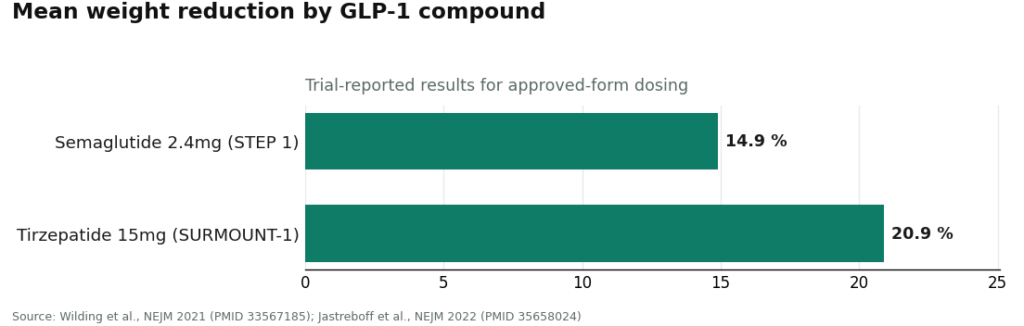
Evidence quality varies a lot by compound, and you should know that before you spend anything. The GLP-1 peptides have solid trial data behind their approved forms: semaglutide showed about a 14.9% mean weight reduction in the STEP 1 trial, tirzepatide about 20.9% at its top dose in SURMOUNT-1.[7][8] Recovery peptides like BPC-157 are a different story, mostly backed by animal and mechanistic research with limited human data, so anyone telling you it’s a proven human therapy is ahead of the science.[9] Buy from a route where the clinician will actually tell you the difference between those two categories, instead of a site that claims everything works.
Questions people actually ask
Where to buy peptides safely without getting burned by a fake product?
Buy from a licensed compounding pharmacy operating under physician supervision. Skip the bulk research-chemical sites. A real pharmacist checks purity, potency, and sterility before it ships to you. Research-chemical vendors answer to nobody, and the lab certificates on their websites are trivially easy to fake. The price gap is real. So is the risk gap.
Where to buy peptides for weight loss when my doctor won’t prescribe them?
Find a telehealth provider that specializes in metabolic health, get a real evaluation, and if it’s appropriate, get a prescription a compounding pharmacy like FormBlends can fill under physician oversight. That keeps a clinician monitoring your labs and adjusting your dose. A cheap vial skips every one of those checks and puts you entirely on your own if something goes wrong.
Where to buy retatrutide peptide, since it’s not FDA-approved yet?
Retatrutide has no approved commercial form as of mid-2025. Anything sold online is either a research chemical or an unverified compounded product with no regulatory backstop. Some compounding pharmacies do prepare investigational peptides for clinical use under supervision, but access outside a trial is narrow and legally messy. Be suspicious of anyone marketing it freely; you genuinely don’t know what’s in that vial.
What do Reddit threads actually get right and wrong about where to buy peptides online?
They’re useful for surfacing real red flags on specific vendors. They get it wrong when they treat anecdotal purity reports like certified lab testing, and they rarely cover what happens medically when something goes bad. No forum post can tell you what’s actually in a vial. Use those threads to sharpen your questions, not to make the final call.
References
1.; FDA does not verify their safety, effectiveness, or quality before marketing. U.S. Food and Drug Administration, “Compounding and the FDA: Questions and Answers.” https://www.fda.gov/drugs/human-drug-compounding/compounding-and-fda-questions-and-answers 2. Poor-quality compounded drugs can be contaminated or contain too much active ingredient, which could cause serious injury or death. U.S. Food and Drug Administration, “Understanding the Risks of Compounded Drugs.” https://www.fda.gov/drugs/human-drug-compounding/understanding-risks-compounded-drugs 3. Section 503A covers compounding for an individual patient after a valid prescription within a state-licensed pharmacy; Section 503B outsourcing facilities register with FDA and follow CGMP. U.S. Food and Drug Administration, “FD&C Act Provisions that Apply to Human Drug Compounding.” 4. FDA warning letter naming retatrutide and tirzepatide as unapproved new drugs and rejecting “Research Use Only” framing (March 31, 2026). U.S. Food and Drug Administration, Gram Peptides. 5. FDA warning letter naming cagrilintide and mazdutide products as unapproved new drugs (March 31, 2026). U.S. Food and Drug Administration, Prime Sciences. 6. FDA on unapproved and counterfeit GLP-1 drugs sold outside the regulated supply chain, including dosing and contamination risk. U.S. Food and Drug Administration, “FDA’s Concerns with Unapproved GLP-1 Drugs Used for Weight Loss.” 7. STEP 1 trial: once-weekly semaglutide 2.4 mg produced a 14.9% mean weight reduction versus 2.4% with placebo at week 68. Wilding JPH, et al. N Engl J Med. 2021. PMID 33567185. 8. SURMOUNT-1 trial: tirzepatide produced a 20.9% mean weight reduction at the 15 mg dose versus 3.1% with placebo at week 72. Jastreboff AM, et al. N Engl J Med. 2022. PMID 35658024. 9. Review of BPC-157 describing wide-ranging activity drawn largely from preclinical and mechanistic studies. Sikiric P, et al. Pharmaceuticals (Basel). 2024. PMID 38675421.